
How to win
Get to 11 points before your opponent. Win a rally as the receiver for +1 point; on your own serve it's +2.
Turn-based pickleball in five minutes: the grid, the turn, the dice and the shots. The game explains the rest.
If you play pickleball, you already know the court. What’s new here is the turn and the dice.
Get to 11 points before your opponent. Win a rally as the receiver for +1 point; on your own serve it's +2.
The court is a 4 × 10 grid: columns A–D, rows 1–10 — like a chessboard. The net in the middle splits it into two halves. The two rows next to the net (5 and 6) are called the kitchen.
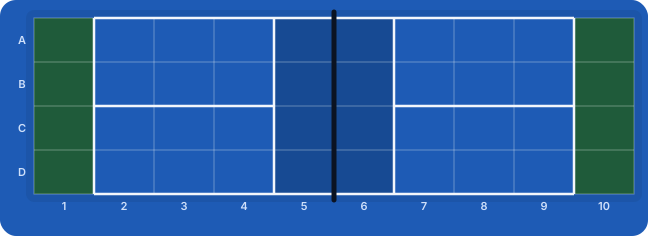
A match begins with the first rally. One player serves, the other receives.
Players take turns. On each turn you choose:
Four things decide how hard a shot is:
Every time you hit the ball, you roll 2 dice.
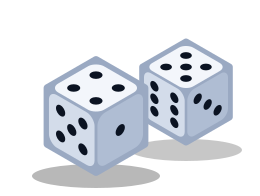
On fast shots and serves, a big overshoot carries the ball past your target: beyond the baseline is out.
Before you receive, you see the landing zone — 4 squares. Choose which one to wait in: it decides which shots you'll have.
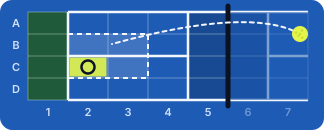
Your character can't move diagonally — only forward, back, left and right. The path to your chosen square is counted in steps: one square, one step.
The more steps you take, the harder the shot.
After your opponent's soft shot the ball travels slowly, so you get a free step. After a fast shot there are no free steps.
Free steps cut the number of steps to your new position.
Example: your opponent hit a soft shot
There are 3 kinds of shots: serves, soft shots and fast shots.
Every shot has its own quirks that shape the rally.
After the bounce, the ball drops one level with every row deeper. You choose where to meet it:
Pop-ups happen near the net. The deeper the ball lands, the lower it bounces.
The full shot guide is in the game, under “Shots”.
A low ball can't be attacked after the bounce. But a slow ball can be volleyed — taken out of the air before it drops.
Say a slow ball is landing in row 2. Step one row closer to the net, into row 3, and you take it on the volley while it's still high: the attack is on.
Only one row in front of the landing square, and only off a slow ball: a fast ball can't be volleyed — it lands behind you, gets past, and the point goes to your opponent.
Pick a square on your opponent's side. Closer to the lines is tougher for them — but more likely to go out.
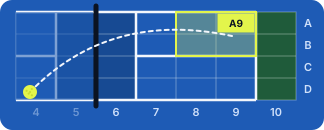
Soft shots are slow: both players have time to move. Fast shots steal your opponent's time, but they're easier to miss.
Usually you hit after the bounce, standing in the landing square. A slow ball can be volleyed — stand one row closer to the net.
On the volley you don't pay a step for the row, the ball doesn't count as low, and the attack is on — a great way to catch your opponent off guard. The price: the roll is 1 harder.
A fast ball behind you is out of reach: it gets past. Your opponent's free steps depend on your shot: after a soft one there's a step, after a fast one there isn't.
You can't volley in 4 cases:
You can send the ball on a diagonal so that after the bounce it jumps out past the sideline.
Your opponent gets a “pulled wide” penalty — their shot gets noticeably harder.
Say you're in A5. Dink to D6 and the ball bounces off the court.
A roll with a margin of 1 or more pulls them wide. Come up 2 short into that corner and it's out.
A hook dink pulls them wide even straight on, A5 to A6. Read the shot descriptions.
Some shots are only available from special spots. They're rare, but they can flip a rally. The ATP, for example, is only on when your character is carrying the “pulled wide” penalty.
Both players start the match with the same set of shots. As the match goes on, you can unlock new ones.
Fill your meter before your opponent does to build a wider arsenal.
Sign a coach to improve your characters' attributes and shots.
Every coach has a contract — the time during which they can train your characters.
A character only improves in ranked matches against other players, and only while a coach's contract is active.
Your rating is your skill level, a number like 3.47. After each match it goes up or down depending on the final score and how strong your opponent was.
Try it yourself
Your first match is with a coach who walks you through the moves on a real court.